The Six-Task Day
You don’t have a time problem. You have a deciding problem.
A short, ordered plan for tomorrow, picked tonight. It rests on one idea: deciding once, the evening before, beats deciding all day long.
- YOU PLAN
- The evening before
- THE LIMIT
- 6 tasks a day
- CORE MOVE
- Work top to bottom
The idea
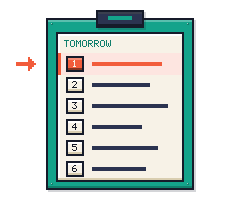
Each evening, write down up to six things to do tomorrow, in order of importance. Next day, work them top to bottom, one at a time. Whatever you don’t finish moves to the next day’s list.
It works because it removes choice from the moment you’re tired or busy. A cap of six forces you to rank, and a fixed order means you never stop to ask “what now?”

How it works
Five minutes each evening, then you work the list in order.
01ANYTIME
Keep one list
Everything you might do goes on one running list.
02EACH EVENING · 5 MIN
Pick six for tomorrow
Up to six, most important first. No more.
03NEXT DAY
Work top to bottom
Don’t start task two until task one is done.
04EVENING
Carry over
Unfinished tasks go first on tomorrow’s six, or back to the list.
REPEAT EVERY EVENING
Then back to step 01.
During the day: new things go on the running list, not on today’s six. Keep routines like taking vitamins off the six. They don’t need choosing.
Signs it’s working
- After a week, you pick tomorrow’s six most evenings, in a few minutes.
- Each morning, you start on task one without deciding anything.
- Most days, the first three tasks get done.
- After a month, few tasks get carried over more than twice.
Common pitfalls
Picking seven or eight
The limit is the point. Move the least important back to the running list.
Skipping the evening pick
Tie it to something you already do at night, or set a reminder.
Carrying the same task every day
It’s too big. Break off a first step you can finish in one sitting.
Letting leftovers pile up
Each evening, put them first or delete them.
Where it comes from
The Six-Task Day is based on the Ivy Lee Method. Here’s the original, what we changed to make it simpler, and how to make it yours.
1 · THE ORIGINAL
The Ivy Lee Method has four rules: write down up to six things to do tomorrow, put them in order, work them top to bottom, and carry over what’s left. It’s named after Ivy Lee, an early public relations consultant. The story usually told is that he gave it to steel executive Charles Schwab around 1918.
2 · OUR VERSION
The four rules were already short, so we kept them all. We added one running list to pick from, so nothing falls off, and a name that says what it does. You can learn it in a day.
3 · YOUR VERSION
To Do Machine starts every system with the fewest rules that still work. That’s on purpose: it’s quicker to learn, and using it shows you what you actually need. Try it as is for a couple of weeks, then change what doesn’t fit.
For example: Six too many on meeting-heavy days? Try four.
GET THIS SYSTEM
To Do Machine can customize this system for you
To Do Machine has this system built-in, ready for you to customize to work exactly how your brain works.