
The Quick Log
Your to-do list should forget things on purpose.
A fast daily page for everything on your mind. It rests on one idea: nothing carries over by itself, so every leftover gets a fresh decision.
- YOU PLAN
- Each morning, briefly
- THE LIMIT
- Nothing carries by itself
- CORE MOVE
- Carry it or strike it
The idea
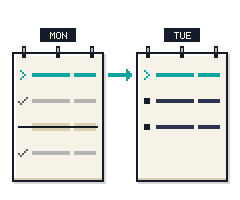
Write one short line for each thing, the moment it comes up. Nothing carries over by itself: each morning, every leftover is moved on, given a later date, or struck out.
Writing something down gets it out of your head. Moving a task again costs a little effort, which makes you ask, “Is this still worth doing?” Tasks that aren’t get struck out instead of piling up.
How it works
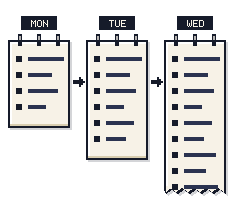
Jot all day. Sort yesterday’s leftovers each morning.
01AS IT COMES UP
Jot it down
One short line on today’s page. Cross it off when it’s done.
02EACH MORNING · 2 MIN
Sort the leftovers
Carry each to today, push it to this month, give it a day, or strike it out.
03ON ITS DAY
This month comes back
Lines that belong to this month, but not today, return to today’s page on their day.
04ON THE 1ST
Next month moves in
Later months wait in the future log. On the 1st, that month’s lines move into this month.
NEW PAGE EACH MORNING
Then back to step 01.
Not a task yet? Ideas, gifts and books to read go in collections, topic lists of their own. Nothing moves forward by itself.
Signs it’s working
- After a week, the morning sort takes under two minutes.
- Few tasks get carried three times; the ones that do get struck out or given a day.
- After a month, your monthly and future logs hold the appointments and bills you’d have forgotten.
- On the 1st, the month’s leftovers fit on one screen.
Common pitfalls
Carrying everything on autopilot
Once a line has been carried three times, decide properly. Give it a day, or strike it out.
Skipping the morning sort
Leftovers pile up. Make it part of your first coffee.
Using today’s page as a wish list
If it won’t happen today, push it to this month.
Big tasks lost in short lines
Keep multi-step work in a collection, and put one next step on today’s page.
Where it comes from
The Quick Log is based on the Bullet Journal. Here’s the original, what we changed to make it simpler, and how to make it yours.
1 · THE ORIGINAL
The Bullet Journal was created by designer Ryder Carroll, who shared it online in 2013 and wrote The Bullet Journal Method (2018). You “rapid log” one short line per thing, with monthly and future logs for what’s later. The heart of it is migration: open items are rewritten, or dropped.
2 · OUR VERSION
We left out the index, the symbol key and the hand-drawn layouts. We kept the parts that do the work: one short line per thing, and a fresh decision on every leftover each morning.
3 · YOUR VERSION
To Do Machine starts every system with the fewest rules that still work. That’s on purpose: it’s quicker to learn, and using it shows you what you actually need. Try it as is for a couple of weeks, then change what doesn’t fit.
For example: Never use the future log? Skip it. Want to track a habit? Add a collection.
GET THIS SYSTEM
To Do Machine can customize this system for you
To Do Machine has this system built-in, ready for you to customize to work exactly how your brain works.